Unitree R1 EDU | U1-U6 | Humanoid Robot | Smart Version
Unitree R1 EDU U1 bis EDU U6 - Smart Version
The Unitree R1 EDU U1 to EDU U6 are programmable humanoid robots designed for research, education, and AI-powered robotics applications. All variants are based on the R1 EDU platform, featuring 26 degrees of freedom, a binocular depth camera, SDK2 and ROS 2 support, and an integrated 40-100 TOPS development computer. With Gigabit Ethernet, Wi-Fi 6, and Bluetooth 5.2, the systems can be flexibly integrated into development and research environments. Depending on the configuration, the platform can be equipped with three-finger or five-finger hands for grasping, teleoperation, imitation learning, and visuotactile research applications.
CZK 536,250
excl. VAT & shipping (are calculated in the final step)
Non-binding inquiry • No online purchase
- Cell design and component selection
- Programming & safety
- Installation
Still have a technical question?Clarify it for free with an RBTXpert
Highlights
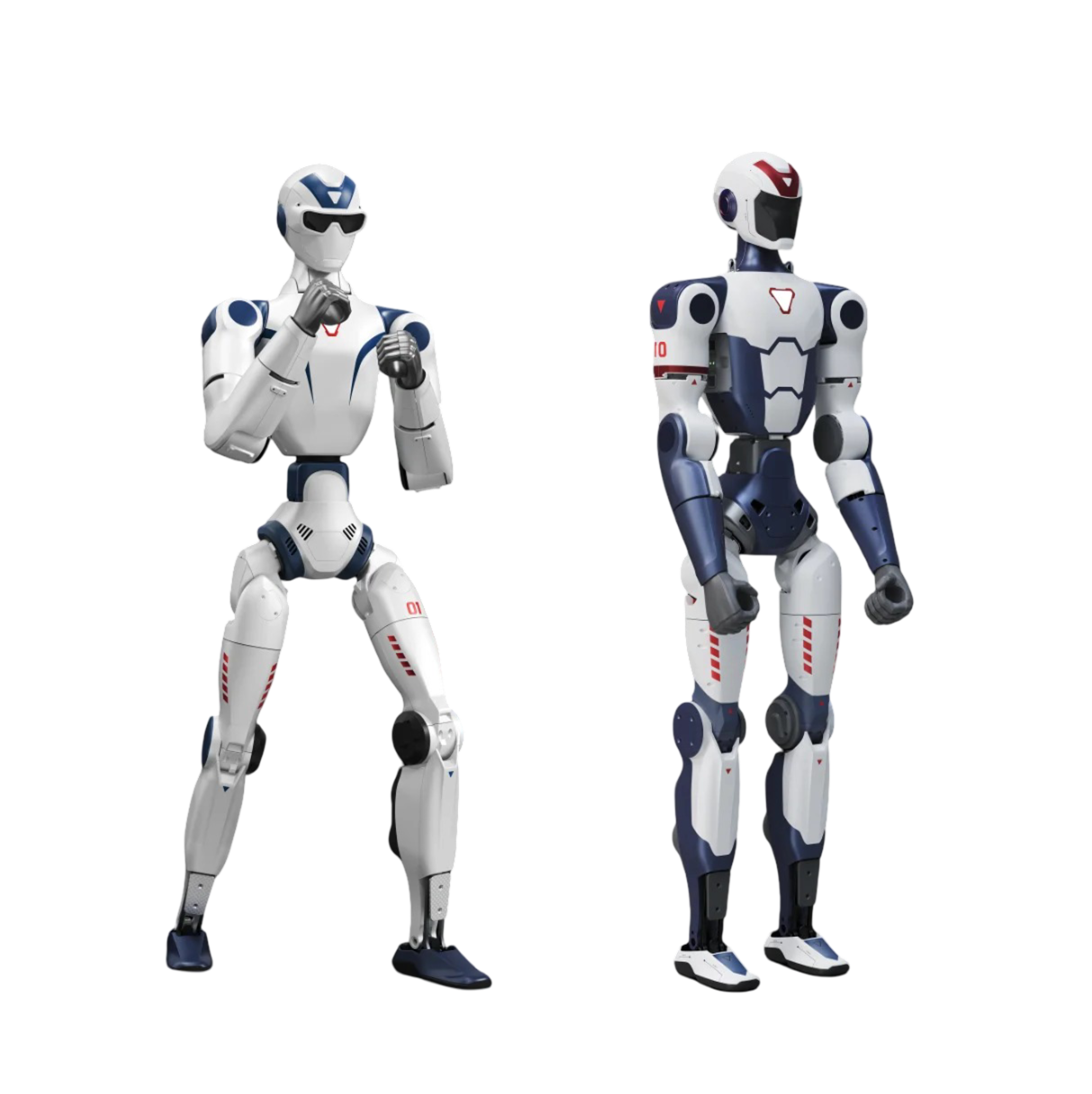
The differences between the development platforms
R1 Base → 26 DOF | 8-core CPU | Stereo camera | No secondary development support | Not programmable
R1 Edu U1 → 40 TOPS AI computing power | High-level & low-level programming | Isaac Sim compatible
R1 Edu U2 → +2 DOF in the head (28 DOF total) | 100 TOPS AI computing power
R1 Edu U3 → Dex3-1 | 2× three-finger hands | 40 DOF total
R1 Edu U4 → Dex3-1 | 2× three-finger hands with tactile sensors | 40 DOF total
R1 Edu U5 → BrainCo Revo 2 Basic | 2× five-finger hands | 38 DOF total
R1 Edu U6 → BrainCo Revo 2 Touch | 2× five-finger hands with tactile sensors | 38 DOF total
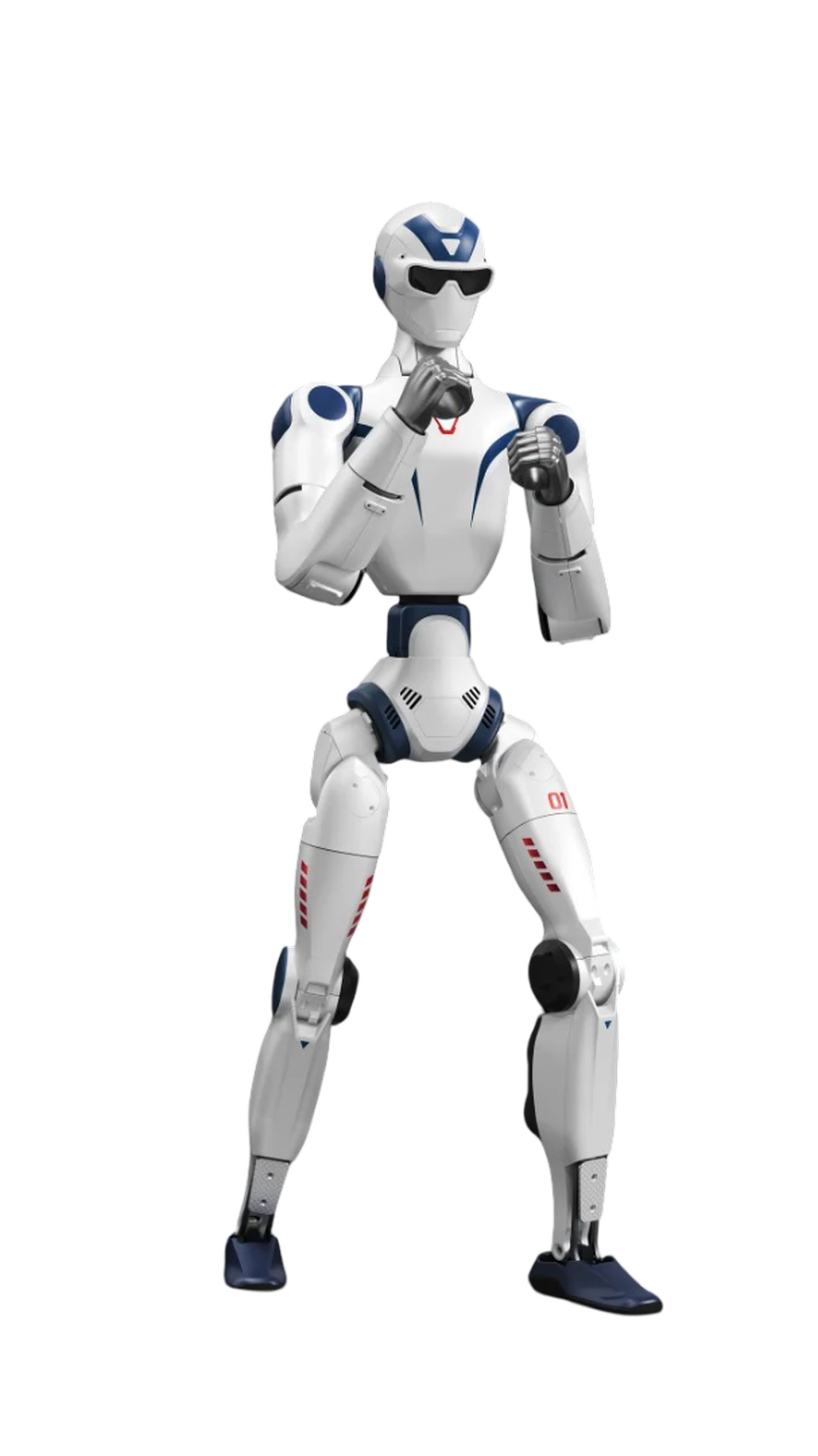
Unitree R1 EDU-U2 - 100 TOPS for Demanding AI Applications
The Unitree R1 EDU U2 is designed for research and development projects that require high local computing power directly on the humanoid robot. Unlike the U1 variant, the U2 features an integrated development computer with 100 TOPS of AI computing performance, providing additional resources for machine vision, object detection, autonomous decision-making algorithms, and embodied AI applications. This enables computationally intensive models to run directly on the robot without relying entirely on external hardware. The platform is particularly well suited for research institutes, universities, and development teams aiming to test modern AI workflows under real-world conditions on a mobile humanoid platform.
Open Development Platform with ROS 2 and SDK2
As the official EDU version, the Unitree R1 EDU U2 provides access to system functions, sensors, and joint control through Unitree SDK2. Official integration options for ROS 2 are also available, along with development environments for Python and C++. This makes the platform an excellent choice for custom research projects in motion control, human-robot interaction, autonomous navigation, and simulation. The open software architecture supports the development of proprietary applications and allows seamless integration into existing robotics workflows. As a result, developers can validate new algorithms and implement complex sim-to-real scenarios on a real humanoid platform.
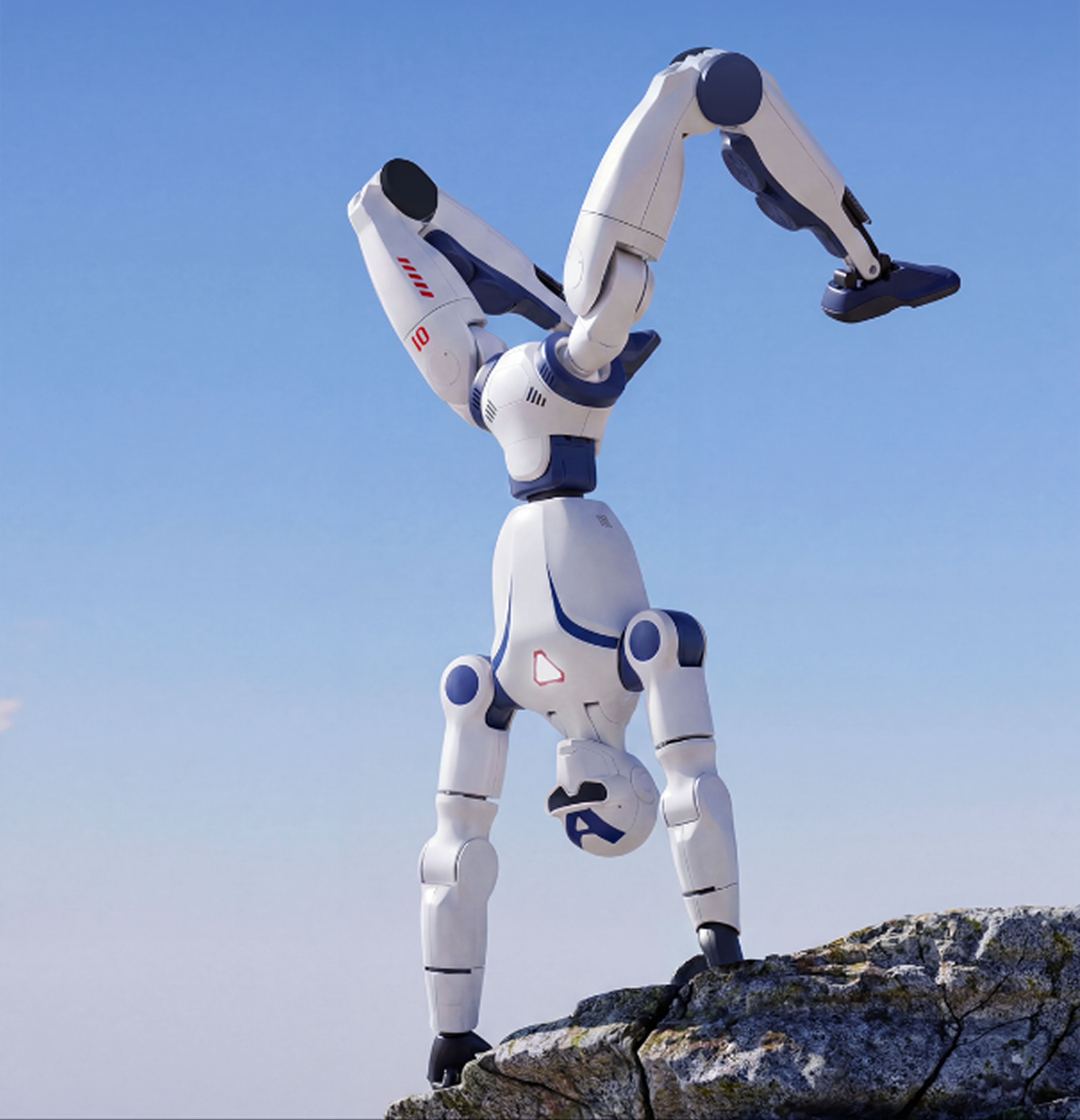
Humanoid Platform with 26 Degrees of Freedom
The Unitree R1 EDU U2 is built on a humanoid robot platform featuring 26 degrees of freedom distributed across the legs, arms, waist, and head. The additional mobility in the head and upper body enables more natural movement patterns and more precise alignment of sensors and perception systems. With a height of 1.23 m, a weight of approximately 29 kg, and a battery runtime of around one hour, the robot remains portable and flexible for a wide range of applications. This makes the system suitable for laboratory environments, live demonstrations, research platforms, and the development of human-like motion strategies.
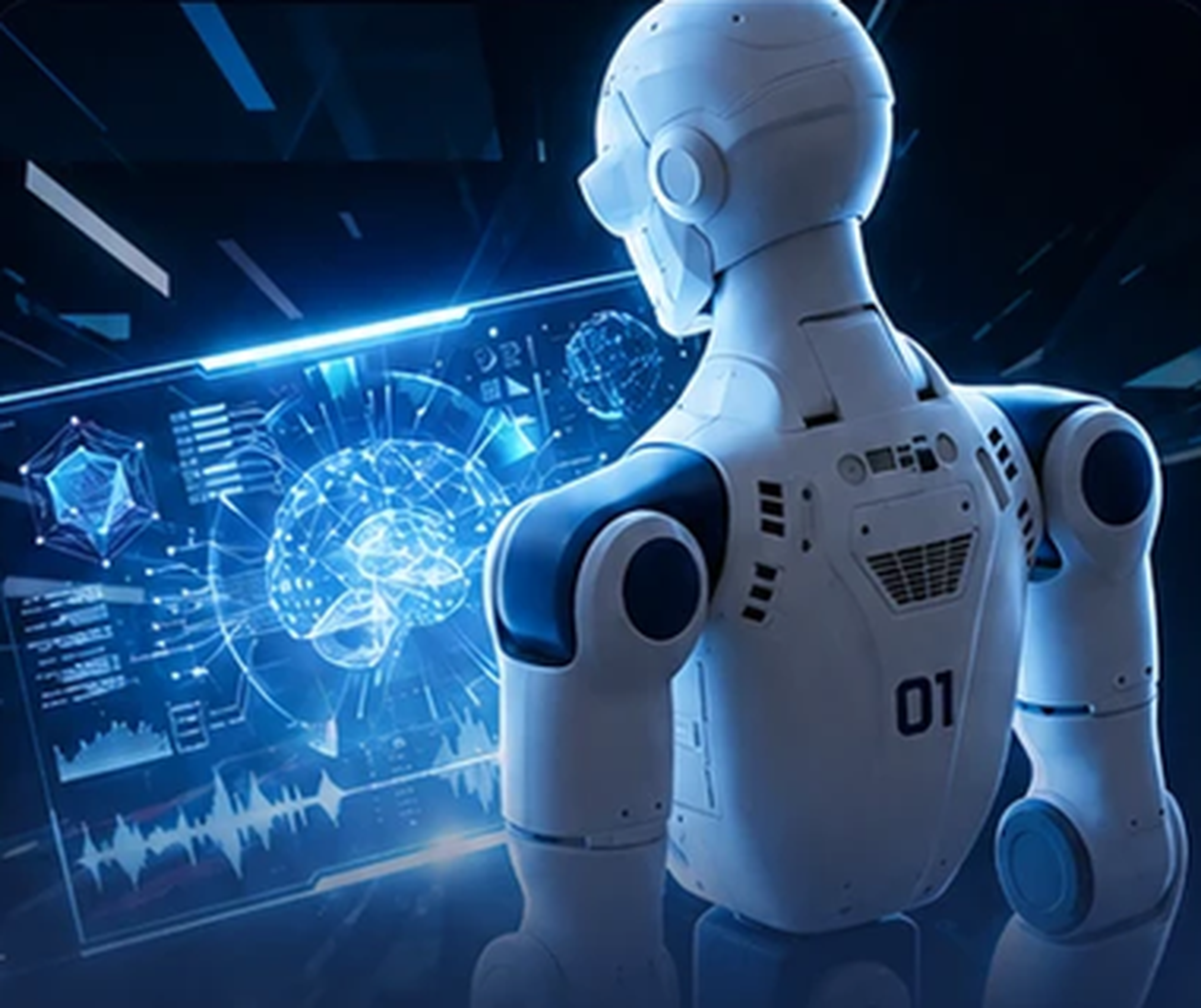
Advanced Sensor Suite and Modern Connectivity
For perception and interaction tasks, the Unitree R1 EDU U2 is equipped with a binocular depth camera featuring a wide field of view, an integrated IMU, a four-microphone array, and onboard speakers for audio interaction. Connectivity options include Gigabit Ethernet, Wi-Fi 6, and Bluetooth 5.2. In addition, the platform provides documented network interfaces for development computers and ROS-based applications. This hardware configuration supports research projects in computer vision, voice interaction, multimodal perception, and autonomous robotics. At the same time, the open communication architecture simplifies integration into existing development and testing environments.
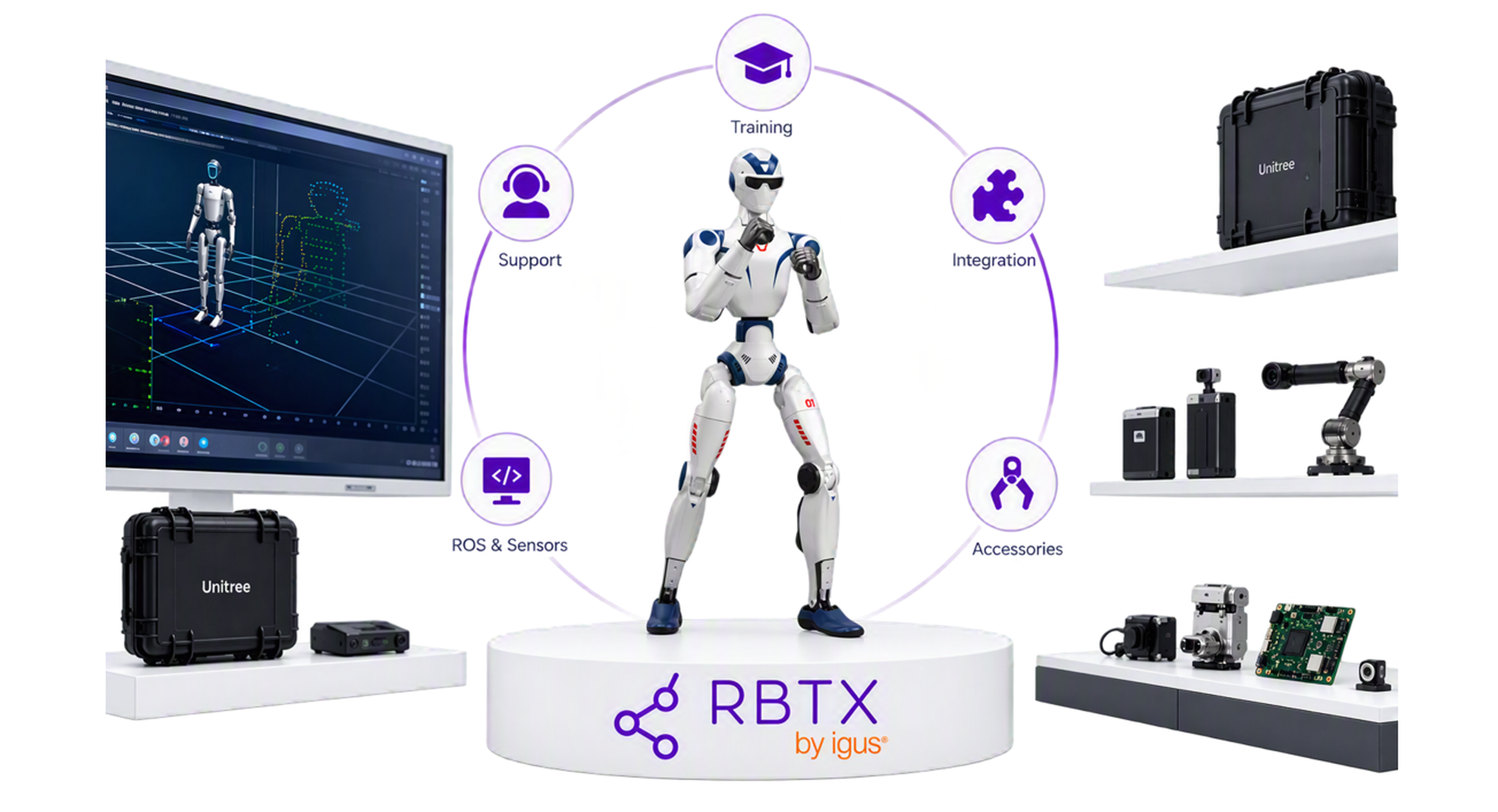
Consultancy, training and integration with RBTX
The Unitree R1 EDU U2 is part of the open robotics ecosystem offered by RBTX. In addition to the hardware, users gain access to technical consulting, integration support, and training services focused on humanoid robotics. RBTX assists with selecting the right configuration, commissioning the system, and integrating it into existing development and automation environments. Complementary accessories such as robotic hands, additional batteries, and compute upgrades are also available. By combining hardware, expertise, and integration know-how, RBTX provides research institutes, universities, and companies with a single point of contact for the successful implementation of humanoid robotics projects.
Differences Compared to the other EDU Variants
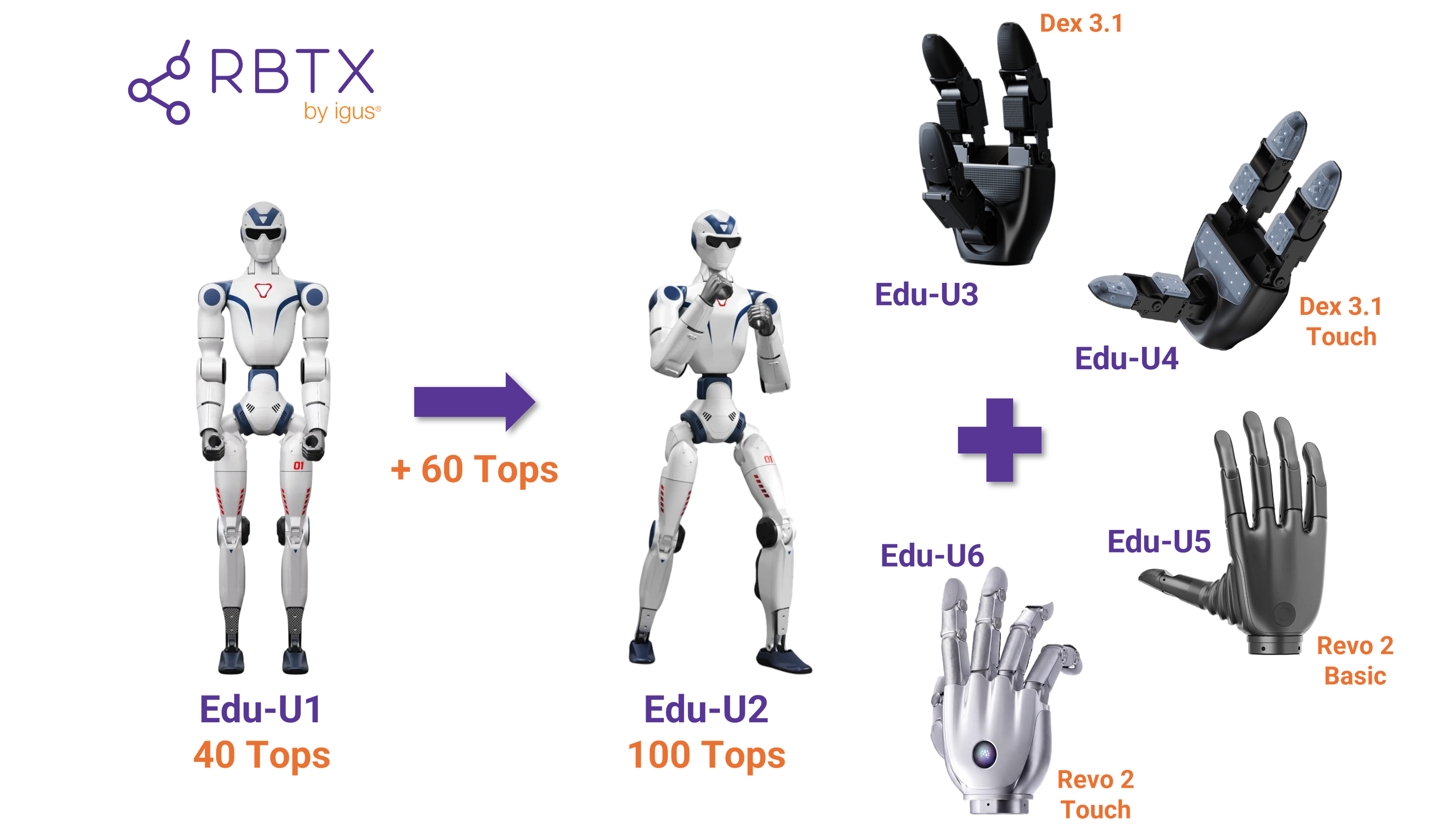
Within the EDU family, the U1 serves as the entry-level configuration with 40 Tops for research and software development. The mechanical platform remains identical across all EDU models, with differences arising from onboard computing performance and optional manipulation hardware.
- EDU U1: Comes with 40-TOPS development computer, no hands, ideal for ROS 2, SDK2, and introductory AI development projects.
- EDU U2: Identical platform with 100 TOPS of computing power for more demanding onboard AI workloads and inference tasks.
- EDU U3: Configuration with two Dex3-1 three-finger robotic hands without tactile sensing.
- EDU U4: Configuration with tactile Dex3-1 hands featuring integrated pressure sensors for visuotactile research.
- EDU U5: Configuration with two Revo 2 Basic five-finger robotic hands for anthropomorphic grasping and imitation learning applications.
- EDU U6: Configuration with Revo 2 Touch hands, including tactile sensing, EtherCAT support, and expanded research capabilities.
Scope of delivery
1× Unitree R1
1× battery
1× controller
1× charger
Item weight: approx.. 25kg
Shipping weight: approx. 40kg